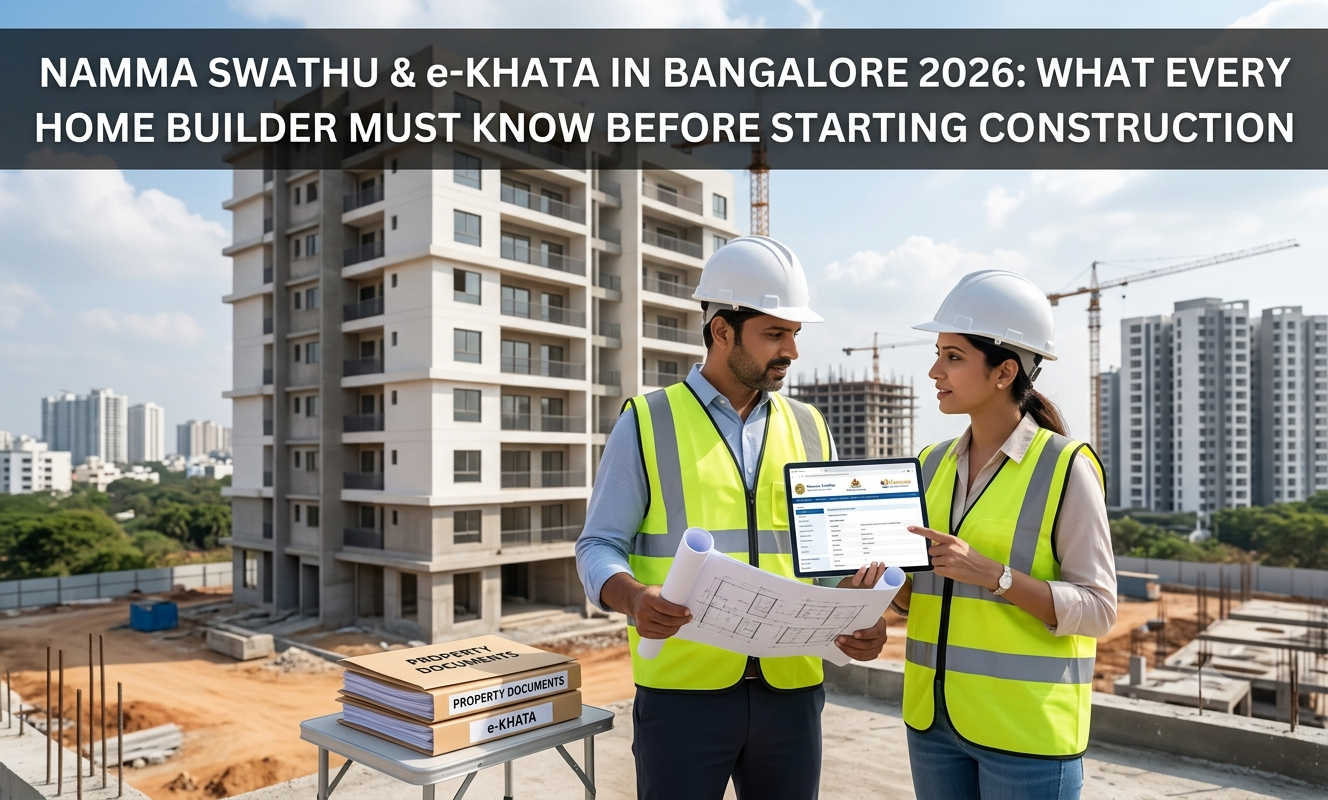
One of our clients, a software engineer from Electronic City, came to us with everything in order. His 30×40 plot in Sarjapur was paid for. Our design team had finalized his floor plan. The construction budget was locked in. We submitted the BBMP building plan application and waited.
It came back rejected.
Not because of the design. Not because of anything on our end. His plot did not have a valid e-Khata under the new Namma Swathu system. What should have been a smooth process turned into a three-month delay while the property documents were sorted out.
We are sharing this not to discourage you, but because this situation is happening to homeowners across Bangalore every week. If you are planning to build your own home in 2026, understanding the e-Khata and Namma Swathu system is the single most important administrative step — and it needs to happen before a single brick is laid.
In this guide, we will walk you through exactly what e-Khata is, why it is now mandatory, how to check your property's status, and how our team at The Urban Construction ensures this is sorted before we ever begin your project.
What Is e-Khata and How Is It Different from the Traditional Khata?
A Khata in simple terms is a municipal property record maintained by BBMP (Bruhat Bengaluru Mahanagara Palike). It tells the municipal body who owns a property, what its area is, and how much property tax is due. For decades, this was a physical document that property owners kept in their files.
In 2024, BBMP transitioned to the e-Khata system, also called e-Aasthi on the official BBMP portal. The e-Khata is a digitally signed, tamper-proof version of the same property record. Physical Khata certificates are no longer issued in Bangalore. If your property's record has not been migrated to the digital system, it effectively does not exist from BBMP's perspective.
Namma Swathu is the Karnataka government's related portal, specifically created for rural and panchayat-jurisdiction properties. For urban Bangalore properties under BBMP, the relevant portal is bbmpeaasthi.karnataka.gov.in. Many people use the two names interchangeably, but knowing which portal applies to your property matters.
Why e-Khata Is Now Mandatory — And What You Cannot Do Without It
The Karnataka government made digitally signed e-Khatas compulsory from 2024 onwards. Since then, three critical property transactions require a valid e-Khata, and without one, you are simply blocked:
1. Building Plan Approval (BBMP)
This is the one that stops home construction in its tracks. When we submit a building plan application to BBMP on your behalf, the portal now requires your property to be registered in the BBMP e-Aasthi database with a valid 18-digit Property Identification Number (PID). No e-Khata, no plan approval. And without plan approval, construction cannot legally begin.
2. Property Registration and Sale
BBMP has integrated its database directly with the Kaveri 2.0 registration system. You cannot buy, sell, or register a property in Bangalore without a valid digitally signed e-Khata. This affects anyone purchasing a plot to build on — the registration itself requires the e-Khata to go through.
3. Home Construction Loans
If you are planning to take a home construction loan from any bank or NBFC to fund your build, the lender will ask for your e-Khata as part of the property documentation. Without it, loan disbursement is delayed or denied.
Understanding the Difference: A Khata, B Khata, and e-Khata
We get this question from almost every client, so let us clarify it once and for all.
| Type | What It Means | Can You Get Building Plan Approval? | Bank Loan Eligible? |
|---|---|---|---|
| A Khata | Property is fully legal, on BBMP assessment rolls, all dues clear | Yes — straightforward | Yes |
| B Khata | Property has legal irregularities — unauthorized layouts, deviations from approved plans, or pending dues | Difficult — requires conversion first | Very limited |
| e-Khata / e-Aasthi | The digital form of either A or B Khata — does not change the property's legal status, only its format | Depends on whether it is e-A Khata or e-B Khata | Depends on the underlying status |
Here is the key point many homeowners miss: getting an e-Khata does not automatically upgrade a B Khata to A Khata status. The e-Khata is the digital wrapper — the legal quality of the property (A or B status) remains the same underneath. If your plot has a B Khata and you get it digitised as an e-Khata, you will still have a digital B Khata, which has limited use for construction approvals.
Documents You Will Need to Apply for or Verify Your e-Khata
Whether your property already has an e-Khata that needs verification, or you are applying for one fresh, you will need to have these documents in order. Our team goes through this checklist during every client's pre-construction site assessment.
- Mother Deed and Previous Sale Deeds — A continuous chain of ownership for the last 15 to 30 years is required. This establishes that the property title is clear.
- Encumbrance Certificate (EC) — From Kaveri 2.0, showing the ownership from the date of last transaction to the present. This confirms there are no outstanding mortgages or charges on the property.
- Property Tax Receipts — Up-to-date payment receipts for the current financial year (FY 2025–26). Unpaid property tax is one of the most common reasons e-Khata applications get stuck.
- Current Sale Deed or Conveyance Deed — Your registered proof of ownership from the Kaveri 2.0 portal.
- Aadhaar Card — For identity verification of all listed owners.
- BBMP Property Identification Number (PID) — This is the 18-digit number your property is assigned in BBMP's database. If you do not have this, it needs to be obtained first.
- Khata Extract and Certificate — If you have an old physical Khata, keep it handy. It helps trace the property in BBMP's older records for migration.
How to Check Your Property's e-Khata Status — Step by Step
You do not need to visit a BBMP office to check your property's status. Here is how to do it online:
- Step 1: Go to bbmpeaasthi.karnataka.gov.in — BBMP's official e-Aasthi property portal.
- Step 2: Enter your Property Identification Number (PID), or search by ward number and street address if you do not have the PID.
- Step 3: If your property appears with a valid 18-digit digital e-Khata ID, you are registered. Note down this number — you will need it for every regulatory submission.
- Step 4: If your property does not appear, or shows as "pending" or "not found", it needs to be registered in the system before any construction activity can proceed.
- Step 5: For panchayat-jurisdiction properties on Bangalore's outskirts, check nammabhoomi.karnataka.gov.in or the Namma Swathu portal for your Gram Panchayat.
What Happens If Your Property Is Under Panchayat Jurisdiction?
Many of the plots we work on — especially in areas like Sarjapur, Varthur, Devanahalli, and parts of North Bangalore — fall under Gram Panchayat jurisdiction rather than BBMP. This is an important distinction because the applicable authority and the portals are different.
Panchayat properties use Namma Swathu, launched by the Karnataka Rural Development and Panchayat Raj (RDPR) department. These properties are registered with the local Gram Panchayat, and building approvals go through the panchayat rather than BBMP.
The good news is that the fundamental requirement is the same — you need a digitally issued property record from Namma Swathu before construction approvals can be processed. The process is slightly different but equally manageable if the documentation is in order.
When you start a project with us, our pre-construction verification process covers both BBMP and panchayat jurisdiction properties. We check the relevant portal, identify any issues, and tell you exactly what needs to be resolved before we move forward.
How We Handle e-Khata Verification for Every Project
At The Urban Construction, we have seen enough projects delayed by document issues to build a systematic pre-construction verification process around it. This is part of our project onboarding — not an afterthought.
Before we submit a single drawing to BBMP, our documentation team:
- Checks your property's e-Khata status on BBMP e-Aasthi or the relevant panchayat system
- Verifies the property boundary against the sale deed and EC
- Reviews Khata status (A or B) and flags any conversions needed
- Checks for outstanding property tax dues that could delay e-Khata issuance
- Confirms the plot's zoning designation under BBMP's Master Plan 2031
If we find an issue — say, unpaid taxes, a boundary discrepancy, or a property not yet migrated to e-Aasthi — we inform you immediately with a clear list of what needs to be resolved and how long it typically takes. We have handled property documentation for hundreds of projects across Bangalore and are familiar with the BBMP office procedures, timelines, and the escalation paths when things move slowly.
The most important thing we can tell you: do not wait until you are ready to build to check your Khata status. Start now. The documentation process can take anywhere from two weeks to three months depending on the property's history, and any delay at this stage pushes your entire construction timeline back.
Frequently Asked Questions About e-Khata in Bangalore
Is e-Khata mandatory even for properties in panchayat areas outside BBMP limits?
Yes. While the exact portal is different (Namma Swathu instead of BBMP e-Aasthi), panchayat-jurisdiction properties also require a valid digital property record before building approvals can be issued. The Karnataka government has standardised this across both urban and rural jurisdictions.
My property has an old physical A Khata. Do I still need to apply for e-Khata?
In most cases, yes. BBMP's building plan portal (and Kaveri 2.0 for registrations) now requires the property to appear in the digital e-Aasthi database with a PID. Physical Khata documents are no longer accepted for these processes. However, if your property is already in the BBMP system with a valid PID, you may already be digitally registered — check on bbmpeaasthi.karnataka.gov.in first.
How long does it take to get an e-Khata in Bangalore?
For properties already in BBMP's assessment rolls with clear documentation, the online migration to e-Aasthi can be completed in 7 to 15 days. For properties with gaps in records, unpaid taxes, or ownership disputes, it can take 2 to 4 months. This is why we recommend starting this process as early as possible — ideally before you finalise your construction plans.
Can I start construction while waiting for my e-Khata?
No. Without a valid e-Khata (or Namma Swathu record for panchayat properties), BBMP cannot issue your building plan approval — and legally, construction without a sanctioned plan is an unauthorised structure. This can result in penalties, demolition notices, or complications when you later try to sell the property or get an Occupancy Certificate.
I recently bought a plot. The seller gave me the physical Khata certificate — is that enough?
A physical Khata certificate shows the previous owner's registration but is not sufficient for 2026 compliance. You will need to do a Khata Transfer — transferring the record from the seller's name to yours in the BBMP e-Aasthi system. This is a separate process from simply having the old document and is one of the first things we verify when you come to us with a newly purchased plot.
Does The Urban Construction help with the e-Khata process, or is that something I handle separately?
We handle the verification and flag any issues for you as part of our pre-construction assessment. For the actual e-Khata application or Khata transfer, we can guide you through the process step by step, connect you with reliable property consultants we work with regularly, and coordinate the timing so it does not delay your construction schedule.
