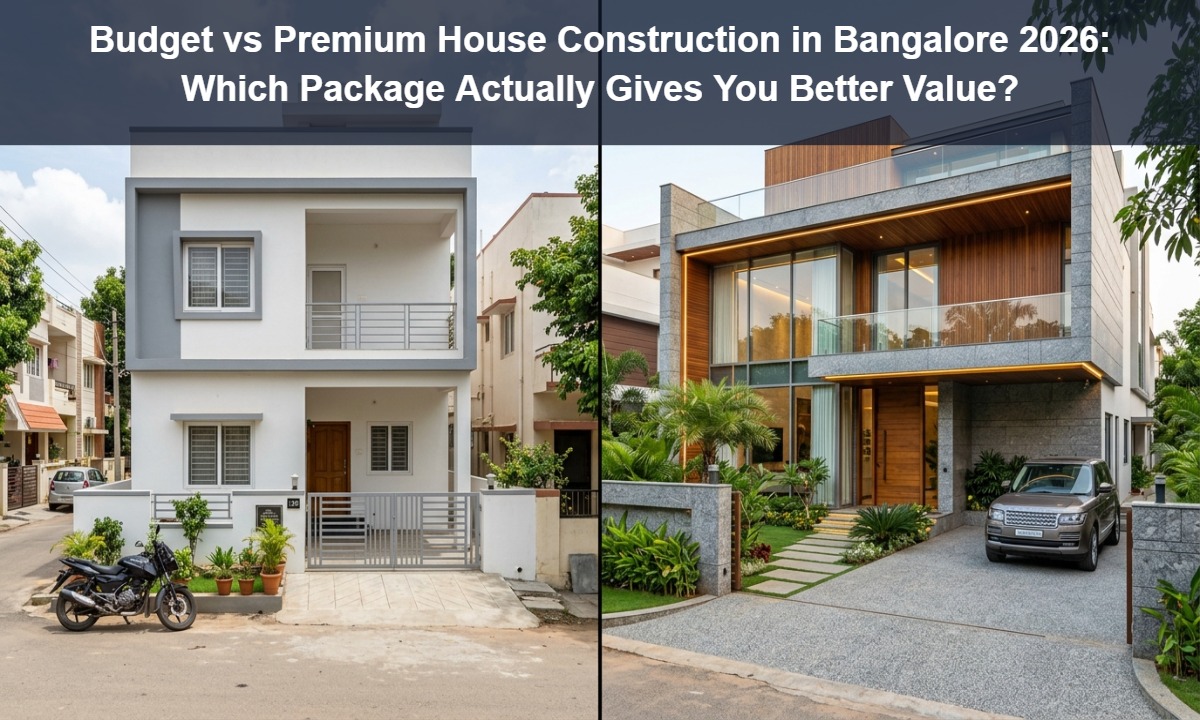
Two homes sit on the same street in Sarjapur Road. Same 30×40 plot. Both built in 2023. Walk into both today and you know immediately which cost ₹35 lakhs and which cost ₹72 lakhs to build — not just from the appearance, but from the feel. The thickness of the walls. The smoothness of the floor. Whether the taps drip. Whether the ceiling shows cracks.
The question is not which one looks better. The question is whether the gap in quality justifies the gap in price — and for your specific situation, which makes more sense.
We have been building homes across Bangalore for over 13 years. In that time, we have seen clients go too cheap and regret it within three years. We have also seen clients overspend on premium finishes they do not use and features they did not need. The right answer is almost always in the middle — but where exactly depends on your priorities, your plot, and your long-term plans for the property.
In this guide, we are going to give you the honest breakdown. What actually changes between a budget and premium construction? Where does the money go? Which package profile matches your situation? And what does our own pricing look like at The Urban Construction?
What "Budget" and "Premium" Actually Mean in Bangalore Construction
The market in Bangalore in 2026 broadly falls into four tiers. These are not universal labels; different companies use different names, but the underlying specifications follow a fairly consistent pattern across the industry.
| Tier | Typical Rate (per sqft, built-up) | What Defines It |
|---|---|---|
| Basic / Economy | ₹1,700 – ₹2,000 | Standard-grade materials, conventional design, basic electrical and plumbing. Functional. No frills. |
| Standard | ₹2,000 – ₹2,500 | Mid-grade materials, some design flexibility, better finish on walls and floors, improved electrical layout. |
| Premium | ₹2,500 – ₹3,200 | Branded materials (Kajaria tiles, Asian Paints, JSW steel), architectural input, quality supervision, better waterproofing and structural specs. |
| Luxury / Smart Home | ₹3,200 and above | High-end materials, custom design, home automation, landscape, premium interiors, superior structural engineering. |
At The Urban Construction, our packages start at ₹1,899 per sqft and go up through Standard, Premium, and Elite tiers. Each tier is not just a price label — it specifies exact material grades for every component, from the cement brand to the bathroom fittings. You can see the full breakdown on our packages page.
Where the Money Actually Goes: The Real Differences Between Tiers
This is where most comparisons fail you. They list "premium tiles" vs "standard tiles" without explaining what that means structurally, aesthetically, or in terms of longevity. Let us break down the five areas where tier differences matter most.
1. Structure and Concrete Quality
The structure — your foundation, columns, beams, and slabs — is the most important part of any building. In budget construction, M20 grade concrete (a standard mix) and basic TMT bars are used. In premium construction, M25 grade concrete with superior density, branded TMT bars (Tata Tiscon, JSW Neosteel), and higher rebar density in critical areas like columns and footings are specified.
Does this mean budget construction falls down? No — M20 is a legitimate structural grade for residential construction. But M25 offers a higher safety margin, better resistance to load over decades, and reduced shrinkage cracking over time. If you are building a G+2 or planning for future additional floors, the structural grade matters significantly more than in a single ground-floor home.
2. Bricks and Masonry
Budget construction typically uses conventional red clay bricks or low-grade solid concrete blocks. Standard and above tiers use fly ash bricks, autoclaved aerated concrete (AAC) blocks, or lightweight cellular concrete. These are not just lighter and faster to lay — they offer better thermal insulation (keeping your home cooler in Bangalore's warming summers), significantly better sound insulation between rooms, and improved resistance to moisture ingress during the monsoon.
3. Waterproofing
In our experience, this is the single area where going cheap creates the most visible, most expensive regret. Budget packages include basic bituminous waterproofing on the terrace. Premium packages include crystalline waterproofing on the terrace, polymer-modified waterproofing in bathrooms and wet areas, and waterproofing treatment at the plinth. In a city that receives 900–1,200 mm of annual rainfall like Bangalore, the difference shows up within the first or second monsoon season — and fixing water ingress post-construction costs far more than the original waterproofing upgrade would have.
4. Electrical and Plumbing
Budget tier uses standard ISI-marked electrical wire (typically Finolex or equivalent base grade) with basic switches and a straightforward conduit layout. Premium tier specifies FRLS (Flame Retardant Low Smoke) wiring, ELCB and MCB protection at every circuit, higher point load ratings for modern appliances, and branded modular switches (Legrand, Anchor Roma, or Schneider). Plumbing upgrades from basic CPVC pipe to premium CPVC or UPVC brands with better pressure ratings and longer warranty terms.
5. Flooring and Finishes
This is the most visible difference but arguably the least structurally important. The budget tier includes standard ceramic tiles at ₹40–70 per sqft. Premium tier includes vitrified tiles at ₹80–150 per sqft, with imported marble or engineered wood options in living areas.
The appearance difference is significant, but the structural difference is minimal. Our advice: do not inflate your entire budget for tiles. Allocate your premium spend toward waterproofing, structure, and electrical — and choose a mid-range tile that works visually without doubling your flooring cost.
Our Package Breakdown — What Each Tier Includes
Rather than speaking in generalities, here is how our packages at The Urban Construction are structured. Every specification is written into the contract — not verbal promises.
| Component | Classic (₹1,899/sqft) | Standard (₹2,199/sqft) | Premium (₹2,599/sqft) | Elite (₹3,099+/sqft) |
|---|---|---|---|---|
| Concrete Grade | M20 | M20/M25 | M25 | M30 + structural audit |
| Steel | Standard TMT Fe415 | Fe500 TMT | JSW / Tata Tiscon Fe500D | Fe550 high-strength |
| Bricks/Blocks | Red brick | Fly ash brick | AAC blocks | AAC + thermal insulation |
| Waterproofing | Terrace only | Terrace + bathrooms | Terrace + all wet areas + plinth | Full building envelope |
| Flooring | Ceramic 60×60 | Vitrified 60×60 | Vitrified 80×80 + marble foyer | Custom — imported marble/wood |
| Electrical Wiring | Standard FRLS Finolex | FRLS + ELCB protection | FRLS + ELCB/MCB per circuit + modular switches | Smart home ready wiring |
| Plumbing | CPVC | Premium CPVC | Astral / Supreme CPVC with warranty | Grohe/Jaquar grade fittings |
| Painting | Asian Paints Tractor Emulsion | Asian Paints Apcolite | Asian Paints Royale | Premium texture + exterior coating |
| Design Support | Standard plan | Customised 2D plan | 2D + 3D elevation | Full architectural + interior design |
| Warranty | 5 years structure | 7 years structure | 10 years structure | 10 years + 2 years finishing |
Which Package Suits Which Homeowner?
There is no single right answer — it depends on your situation. Here is a practical framework we use with our own clients.
🏠 The First-Time Builder on a Tight Budget
You have bought your plot by stretching finances and need to keep construction costs low. You plan to live in the house immediately and upgrade later. Our recommendation: Classic or Standard package. Focus extra budget on structural and waterproofing upgrades within the package; these cannot be fixed later without breaking walls. Keep tiles and finishes basic for now; these are easy to change in the future.
💼 The Professional Building for Long-Term Self-Occupation
You are building your permanent home, planning to live in it for 20+ years, and have reasonable financial flexibility. Our recommendation: Premium package. The structural quality, waterproofing, and branded materials will serve you for decades with minimal maintenance. The higher upfront cost pays for itself in avoided repair and maintenance expenses within 8 to 10 years.
📈 The Investor Building for Rental Income
Your plan is to build a G+1 or G+2 home, live in one unit, and rent out the others. Our recommendation: Standard to Premium depending on the rental market in your area. Rental yields in Sarjapur, Whitefield, and HSR Layout respond well to quality — better-finished properties command ₹3,000–8,000 more per month in rent, which means the premium package pays back its cost difference in 4 to 6 years through higher rental income alone.
🌟 The Aspirational Builder Who Wants a Landmark Home
This is the home you have planned for years. You have a clear vision, you want quality materials and contemporary design, and you are not looking to compromise. Our recommendation: Elite or Smart Home package. The design team involvement, structural quality, and material specifications will give you the home you have envisioned — built to last 50 years with minimal maintenance.
The Long-Term Cost Argument: Why Premium Often Wins
Here is a calculation that does not get discussed enough in the industry. Let us compare two versions of the same 1,800 sqft home on a 30×40 plot:
| Cost Factor | Classic Package (₹1,899/sqft) | Premium Package (₹2,599/sqft) |
|---|---|---|
| Initial construction cost | ₹34.2 lakhs | ₹46.8 lakhs |
| Waterproofing repairs (Year 3–5) | ₹1.5 – 2 lakhs (common in basic packages) | ₹0 (covered by waterproofing warranty) |
| Repainting (Year 5) | ₹80,000–1 lakh | ₹50,000–70,000 (exterior coat lasts longer) |
| Plumbing repairs (Year 4–8) | ₹50,000–1 lakh (lower-grade pipes show leaks) | Minimal (premium CPVC with warranty) |
| Electrical upgrades (Year 5) | ₹40,000–80,000 (adding points for appliances) | Pre-planned load capacity, minimal upgrades |
| 10-Year Total Cost | ~₹37.5 – 39 lakhs | ~₹48 – 49 lakhs |
| Resale value premium | Standard market rate | 8–15% above comparable properties (branded materials, better finish) |
The gap narrows significantly over a 10-year horizon. And when you factor in resale value, a well-built premium home in Bangalore often reclaims the entire construction cost differential through higher transaction price.
The Hidden Cost of Going Too Cheap
We will be direct here because we have seen it happen too many times. When clients choose the absolute cheapest construction option without understanding what they are giving up, three things tend to happen.
First, waterproofing failures show up in the first or second monsoon season. Terrace leaks, bathroom seepage, and wall moisture are not minor inconveniences; they require breaking into finished walls and floors to fix properly. The repair bill is often 30 to 50% of what the waterproofing upgrade would have cost at construction time.
Second, the structural quality becomes visible over time. Hairline cracks that appear in walls and ceilings within three to five years are not just cosmetic — they signal concrete that shrank, settled, or was mixed with insufficient water management during curing. These are difficult and expensive to address after the fact.
Third, lower-grade electrical systems create ongoing problems as appliance loads increase. Indian households in 2026 run air conditioners, inverters, EV chargers, and high-wattage kitchen appliances that a basic 2018-era electrical layout was not designed for. Rewiring a finished home is extremely disruptive and expensive.
How to Decide Which Package Is Right for You
When a client comes to us for the first time, we do not push them toward the most expensive package. We ask four questions:
- What is the intended use? Self-occupation, rental, resale, or a combination?
- How long do you plan to stay? Short-term (less than 10 years) vs long-term (20+ years) changes the ROI calculation significantly.
- What is your realistic budget including land, approvals, and construction? Many clients underestimate the non-construction costs (see our cost breakdown guide for details).
- What are your non-negotiables? Some clients will not compromise on waterproofing and structure. Others care most about aesthetics. Knowing your priorities helps us allocate your budget where it matters most to you.
Once we understand these four things, we can put together a realistic package recommendation and show you exactly what you get at each price point in writing, before you sign anything.
Frequently Asked Questions
Is there a quality difference between contractors who offer the same sqft rate?
Absolutely — and this is the most important thing to understand. Two contractors quoting ₹2,200 per sqft can deliver vastly different results depending on material specifications, supervision quality, and construction practices. Always ask for a written Bill of Quantities (BOQ) that lists specific material brands, grades, and quantities. A verbal quote without a BOQ is not comparable to another verbal quote at the same price.
Can I mix-and-match — premium structure but basic finishes?
Yes, and this is actually a strategy we encourage for budget-conscious clients who want long-term structural quality. You can choose our Premium package for structure and waterproofing specifications while selecting mid-range options for finishes like tiles, paint, and fittings. We build flexibility into our packages specifically for this reason. Talk to our team about a customized specification.
How do I know the materials specified are actually used during construction?
This is a legitimate concern. At The Urban Construction, every material delivery is logged and photographed. Our site supervisors verify each delivery against the contracted specification, and clients receive WhatsApp updates on material milestones. We also maintain a client login portal where progress and material logs are updated weekly. If a specified material is unavailable, we get written approval before substituting — never silently.
What happens if I want to upgrade mid-construction?
It is possible in most cases, and we handle upgrade requests regularly. However, some changes are far easier early in construction than late. Structural upgrades (concrete grade, steel specification) must be decided before the foundation is poured. Electrical point additions are easy to accommodate before walls are plastered. Tile and finish upgrades can happen until the finishing stage begins. We maintain a change order process where upgrades are priced and approved in writing before implementation.
